
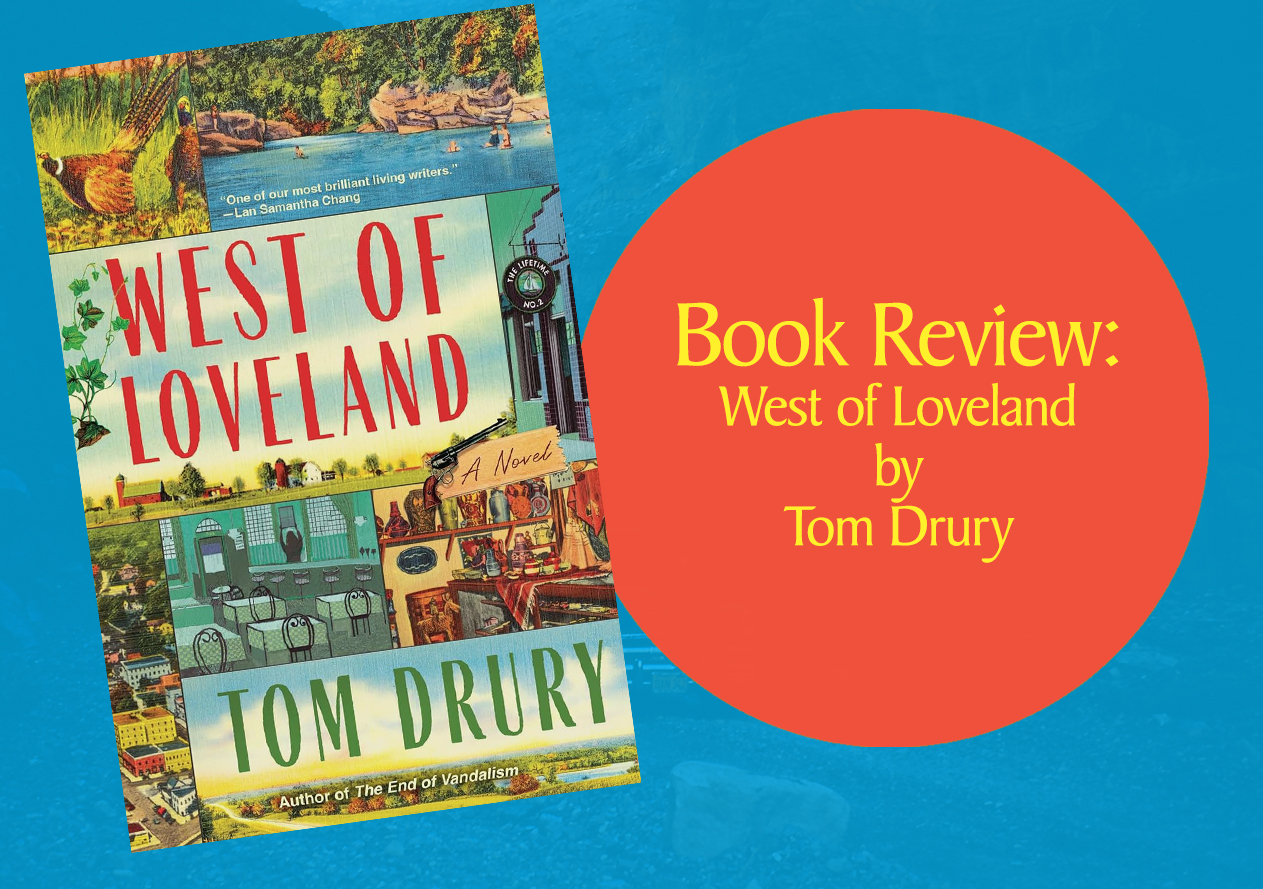
Reviewed: West of Loveland by Tom Drury
Release Date: Nov 3, 2026
Published by Grove Press
Reviewed by Brett Van Emst
Tom Drury is back with another life update on the characters of Grouse County and it’s about time! The story that started with The End of Vandalism (1994) and went through Hunts in Dreams (2000) and Pacific (2013), now gets an update with West of Loveland. And for those of us who love these books and Drury’s writing, the biggest problem is remembering what has happened in previous books since it appears that Drury revisits the characters every 13 years or so.
But the pace of the release of the books matches Drury’s pace of storytelling. All the action that happens in West of Loveland could have come from a newspaper article. The other 350+ pages are why serious readers keep coming back to Drury.
The writing seems a mash of juxtaposition: other worldly yet coldly and starkly realist, vast yet small, epic yet a simple tale. A midwestern tale about everyone in the world.
Grouse County, which I had to google to make sure doesn’t exist, is full of characters on moral and self-discovery while at the same time being a place of scoundrels, scofflaws and adulterers. While even minor characters are wholly formed and given life, the novels follow (mainly) the life of now-retired small-time crook Charles “Tiny” Darling or people close to him: His now ex-wife Joan, Sheriff Dan Norman (now married to Tiny’s first ex-wife) and Tiny and Joan’s children (Micah and Lyris (from another father) are also followed on some side treks (with Pacific being mostly about Micah (Tiny and Joan’s son) making a move to California). Got that?
West of Loveland is a homecoming of sorts, with all the old characters coming around Tiny except for Joan, who is still in California. And there are a new set of characters added to this book: mainly teenage (and “Q”uestioning) Rocky who, along with his mother-like aunt, sets all the action in motion by finding a discarded gun on the side of the road. The gun sets off a slow yet constant police/crime storyline (the previously mentioned newspaper article).
The one thing Drury does leave out are the distractions of everyday living. The people here are wise, soft-spoken and in pursuit of finding, and being okay, with themselves in an authentic way.
The teenagers are interesting and do things like go swimming in the local quarry (rather than play Minecraft every night). The next generation up seems unmoored in a healthy, free sort-of-way (Micah shows back up with his girlfriend as they are on their way to work a harvest in Vermont). The middle agers in the book are still following their dreams. And the older generation, Tiny among them, are still finding love.
Drury’s storytelling ability is fully on display in this novel. The “newspaper article” is fully expanded into a massive generational and regional story following at least a dozen (maybe more?) characters adding to the tracking down of the history of this gun. Drury gives space for doctors and cops and small-time criminals and illegal bar owners to have medium sized parts in the tale. Yet the extra character build up never seems like an unnecessary diversion. In fact, quite the opposite: it seems like the whole point. It’s novels like these that get passed on by word of mouth for years to come.
Drury admits it’s an aspirational novel intending the book to be “a quiet homage to American democracy… about a way of life we could have if we make it so”. It’s a departure from the first 3 books in this story as most of those end in broken relationships and, in Pacific, the implied doom that Micah is heading toward. A happy ending? One might have to wait another 13 years to find out.


